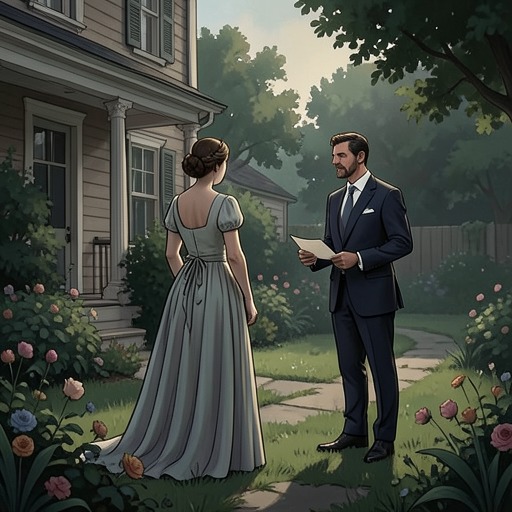
Marriage of Anthony Cade and Virginia Revel
The Secret of ChimneysAnthony Cade and Virginia Revel’s marriage changes the stakes of the planned Herzoslovakian restoration: the man who has just revealed himself as Prince Nicholas is already married, and he intends his English wife to reign beside him as queen. Disclosed first as an unexpected qualification—and complication—for the throne, the marriage becomes a partnership whose prospective future is as dangerous as it is romantic.
The Marriage Disclosed
Anthony announces the marriage to Baron Lolopretjzyl almost as an afterthought. The Baron has risen and clicked his heels together, solemnly describing it as the proudest moment of his life to see Anthony become King of Herzoslovakia. Anthony then tells him that there is a string attached: he is married. The announcement punctures the Baron’s ceremonial confidence. He retreats, dismayed, and immediately imagines that Anthony has married a Black woman in Africa. Anthony laughingly corrects him, and the Baron settles on the possibility of a respectable morganatic marriage—a union that would leave the succession intact while withholding full royal standing from the wife.
Anthony rejects that compromise. Virginia is not to be tucked away in a morganatic arrangement; she is to play queen to his king. He argues that she is qualified for the position, pointing to her descent from an English peer whose family reaches back to the time of the Conqueror and to her knowledge of Herzoslovakia. The moment thus moves beyond a revelation of marital status: Anthony publicly makes Virginia’s place beside him part of the political future he is discussing.
Virginia’s Identity and the Court’s Response
The marriage’s political implication becomes unmistakable when George Lomax, startled out of his normally careful speech, asks whether the woman Anthony means is Virginia Revel. Anthony confirms her identity. The recognition ties the proposed queen not to an unknown foreign bride but to a person already known to the company. Lord Caterham responds with congratulations, calling Virginia delightful; Anthony accepts the praise and adds that she is more than the compliment suggests.
Herman Isaacstein approaches the news differently. Rather than congratulating Anthony, he asks when the marriage took place, addressing him as Your Highness. Anthony answers that he married Virginia that very morning. The precise timing matters: this is not an old marriage newly brought to light after the restoration plan has taken shape, but a union contracted on the day the political identity behind Anthony Cade is disclosed. The short interval makes the revelation feel immediate and forces the assembled men to reckon with a new fact that cannot be fitted away as a distant personal history.
A Royal Identity Reframes the Union
The scene’s full significance emerges when Anthony later tells Virginia the confession he has withheld: he is really Prince Nicholas Obolovitch of Herzoslovakia. Virginia reacts with delighted astonishment at having married him. Their exchange reverses the apparent order of the earlier disclosure. At the gathering, Anthony’s marriage had seemed like a complication in the Baron’s vision of a king; in private, the revealed royal identity makes the marriage itself a question of queenship and succession.
Anthony proposes that they go to Herzoslovakia and pretend to be king and queen. His phrasing retains a comic lightness, but the prospect is not presented as a harmless costume: he invokes Jimmy McGrath’s warning that the average life of a king or queen there is under four years. The line brings the country’s political danger directly into the newly disclosed marriage. Virginia does not recoil from the risk; she says she will love it. Her response makes the proposed journey a shared choice rather than a role assigned to her by Anthony alone.
Partnership and Political Consequence
The marriage joins two kinds of qualification that the restoration scene keeps in view. Virginia’s English aristocratic ancestry answers the Baron’s concern about her suitability for royal standing, while her knowledge of Herzoslovakia distinguishes her from a merely decorative consort. Anthony’s insistence that she will be queen, rather than a morganatic wife, makes the status of their relationship integral to his claim and to the imagined royal household.
The exchange also shifts the meaning of Anthony’s new identity. His confession does not dissolve the relationship into a political arrangement: he presents Virginia as the person who will share the role, and her eager acceptance supplies the answer to the danger he has named. The book closes the episode not with a coronation or a settled restoration, but with the couple contemplating a hazardous future together. Jimmy McGrath’s approving aside—asking whether Virginia is not great—recognizes her enthusiasm as the last beat of the scene. Marriage has made the prospective crown a joint undertaking, while leaving its political outcome uncertain.